
We Are Not for Sale”: Greenland Pushes Back as Trump Eyes the Territory

It started as rhetoric.
Then it stopped feeling abstract.
On the streets of Nuuk, Greenland’s capital, the mood is no longer just uneasy — it is openly defiant.
“The people of Greenland do not want to become American,” said Mia Chemnitz, a 32-year-old business owner. “We are not for sale.”
Her words echo a growing sense of fear and indignation across the world’s largest island as the Trump administration openly discusses acquiring the territory, which has been part of the Danish realm for centuries. White House officials have confirmed they are “actively” exploring an offer to buy Greenland — and have declined to rule out the use of force.
For many Greenlanders, that language alone has crossed a line.
From Hypothetical to Personal
Concern turned into alarm after U.S. forces seized Venezuelan President Nicolás Maduro in Caracas and transferred him to New York on drug-trafficking charges — an unprecedented move that signaled how far Washington might be willing to go.
“That's when it stopped feeling theoretical,” said Tupaarnaq Kopeck, 40, who now lives in Canada — another country Trump has publicly mentioned in annexation rhetoric.
“For the first time, I called my sister in Greenland and told her: if the unthinkable happens, you have a place with us.”
Political Leaders Call It a Threat
Greenland’s representatives in Denmark have reacted sharply.
Aaja Chemnitz, one of two Greenlandic members of the Danish parliament, described the Trump administration’s comments as “a clear threat.”
“It’s deeply disrespectful to refuse to rule out annexing another country — especially a NATO ally,” she said. “I was appalled.”
Greenland, home to about 56,000 people, is sparsely populated and largely covered in ice. Most residents live along the southwestern coast. But its strategic importance to the United States is undeniable.
The U.S. has maintained a military presence there since World War II. Greenland’s position between North America and the Arctic makes it a critical site for missile detection and early warning systems.
More recently, attention has shifted to what lies beneath the ice: rare earth minerals and other resources becoming more accessible as climate change accelerates ice melt.
“We Are Too Small for These Threats”
For journalists and ordinary citizens alike, the scale imbalance is unsettling.
“It’s not easy being 56,000 people and hearing this kind of talk from a superpower,” said Masaana Egede, editor of Greenlandic newspaper Sermitsiaq. “People are genuinely nervous. This is not something we can brush off.”
While experts agree the U.S. could easily take Greenland militarily, they also warn such a move would effectively shatter NATO.
After Trump reignited the issue, six European allies released a statement emphasizing that Greenland’s future must be decided by its people. While welcomed, some Greenlanders fear words alone may not be enough.
“As a Greenlander, you start wondering what we’re really worth to our allies,” Chemnitz said. “Would they act — or just issue statements?”
 Independence, But Not This Way
Polling consistently shows Greenlanders support eventual independence from Denmark — but overwhelmingly reject becoming part of the United States.
The territory is largely self-governing, though Copenhagen still controls defense and foreign policy.
Some voices, however, are more resigned.
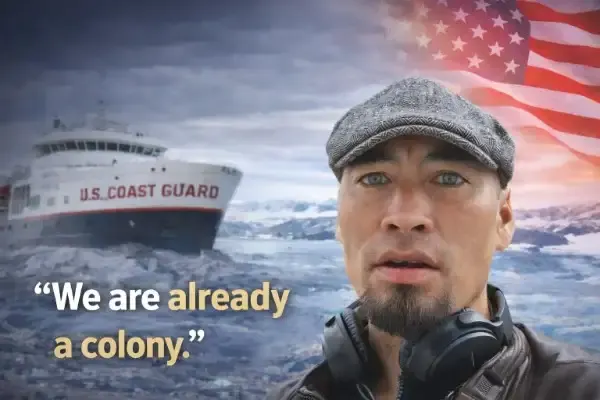
Aleqatsiaq Peary, a 42-year-old Inuit hunter in the remote town of Qaanaaq, said U.S. ownership wouldn’t change much.
“It would just be switching from one occupier to another,” he said. “We are already a colony.”
But his real concern lies elsewhere: melting sea ice that is destroying traditional livelihoods.
“I don’t have time for Trump,” he said. “Our people are struggling to survive.”
A False Choice, Many Say
For Greenlandic leaders, the danger is being forced into a binary decision they never wanted.
“This cannot become a choice between the U.S. and Denmark,” Egede said. “That is not what Greenlanders want.”
Others worry that longstanding ties with Washington are being damaged.
“People here are irritated — and scared,” said Christian Keldsen of the Greenland Business Association. “We are open, welcoming people. But this has shaken trust.”
Greenland, he stressed, is already open for business with the U.S. Direct flights to New York now operate regularly.
“They don’t need to take us over,” he said.
Chemnitz agrees.
“We are a functioning democracy. A NATO ally. The U.S. has had bases here for 70 years,” she said. “We are not for sale — but we are open for business.”
FAQ’s
Q1. Why does the United States want Greenland?
Greenland is strategically important due to its Arctic location, U.S. military presence, and growing access to rare earth minerals as ice melts because of climate change.
Q2. Can the U.S. legally buy Greenland?
No. Greenland is a self-governing territory within the Kingdom of Denmark, and both Danish and Greenlandic leaders have repeatedly said the island is not for sale.
Q3. How do Greenlanders feel about Trump’s comments?
Many Greenlanders describe feeling anxious, disrespected, and alarmed. While there is support for eventual independence from Denmark, there is strong opposition to becoming part of the United States.
Q4. Could Greenland be taken by force?
Experts say a military takeover would be geopolitically catastrophic, likely collapsing NATO and triggering severe international backlash, making it extremely unlikely.
🔗 For more US political, Global and energy-related news: (Click Here)


